
Psoriasis
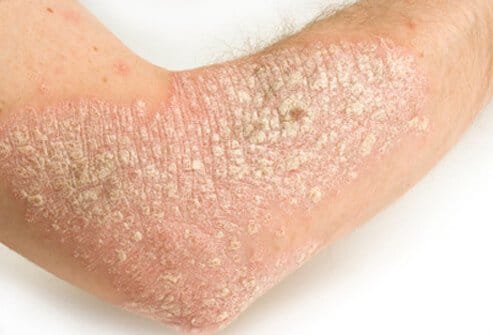
An inflammatory skin disease that appears as raised and red patches of skin is called Psoriasis. It occurs at any age and once developed, keeps coming and going throughout the life. Psoriasis is prone to flare-up of the condition which can occur at any point of the disorder being resident on skin. It is generally not contagious and is caused due to bad immune system wherein skin cells tends to grow abnormally.
There are various types of Psoriasis:
Plaque
This is invariably the most common type which shows red, thick patches which are extremely itchy. Mostly appearing on knees, elbows, lower back and scalp.
Guttate
These are relatively small, red and scaly spots that show on arms and legs. It is a usual eruption after some illness like bad throat or fever. This type is more common in people who are already suffering from plaque type.
Pustular
As the name suggests, these are red, swollen bumps that have pus filled in them. These pus-filled bumps appear only on the palms and soles of feet and is extremely painful.
Inverse
This is a different condition where smooth (not raised) red patches at areas of skin folds like groins, armpits and under breasts are developed. Skin is usually extremely raw and uncomfortably sore.
Erythrodermic
In this type of Psoriasis, the entire skin surface becomes red and flaky. This is a severe condition and needs emergency treatment. In this condition the body is unable to keep the normal temperature, making the heart restless and abnormally loaded. Under this type of condition, patient suffers serious metabolic disturbances and must be hospitalized immediately.
Psoriasis also affects nails and causes pitting, discoloration, thickening and sometimes separation of nail plates from surface. In some severe cases, it also affects joints and causes arthritis.
What is the treatment for Psoriasis?
Like many other resident skin disorders, Psoriasis is also devoid of permanent treatment and the patients will only have to rely upon temporary reliefs with lifelong medication.
There are several treatment options available for Psoriasis with certified dermatologists which are:
- Topical Agents such as Corticosteroids, Coaltar, Dithranol, Retinoids, Vitamin D analogs.
- Phototherapy PUVA, Narrow Band UVB.
- Systemic Agents such as Retinoids, Methotrexate, Ciclosporin.
- Biological Therapies – Infliximab, Etanercept, Adalimumab, Ustekinumab, Alefacept.
A thorough diagnosis must be done before deciding the appropriate treatment for the patient. The chosen therapy usually depends upon the diagnosed condition, patient’s current health profile, the severity of the disease, complications involved and co-existing ailments.
One must consult expert and experienced dermatologists who can develop the most suitable treatment strategy to bring relief.
To book an appointment for Treatment for Psoriasis in Delhi with Dr. Sumit Gupta, contact us at: +91-9560064696 or info@anoopam.sjos.in